'/%3E%3C/svg%3E)
'/%3E%3Cpath%20fill='%23b2b2b2'%20d='M241%20382q0%2016%2017%2026%2017%2011%2042%2011t42-11q16-11%2017-26V269H241'/%3E%3Cpath%20fill='%239f7e00'%20d='M241%20379q0%2014%208%2023%209%209%2021%209%2014%200%2021-9%209-9%209-23V269h-59'/%3E%3Cpath%20d='M241%20339v-70h59v110q0%2014-9%2023l-6%205v-68h-15v72q-8%200-14-4v-68zm59%2040c0%2022%2015%2032%2029%2032%2021%200%2030-18%2030-32v-40h-59'/%3E%3Cpath%20fill='%239f7e00'%20d='M266%20277v5h2v12h-3v-5h2v-5h-9v5h2v5h-4v9h3v18h-5v10h34v-10h-5v-18h3v-9h-4v-5h2v-5h-9v5h2v5h-3v-12h2v-5zm42%20101q0%2010%206%2017%206%206%2015%207%2010-1%2016-7%206-7%206-17v-29h-43'/%3E%3Ccircle%20fill='%230044ad'%20cx='329.5'%20cy='372'%20r='6'/%3E%3Cellipse%20fill='%230044ad'%20cx='300'%20cy='340'%20rx='16'%20ry='21'/%3E%3C/svg%3E)

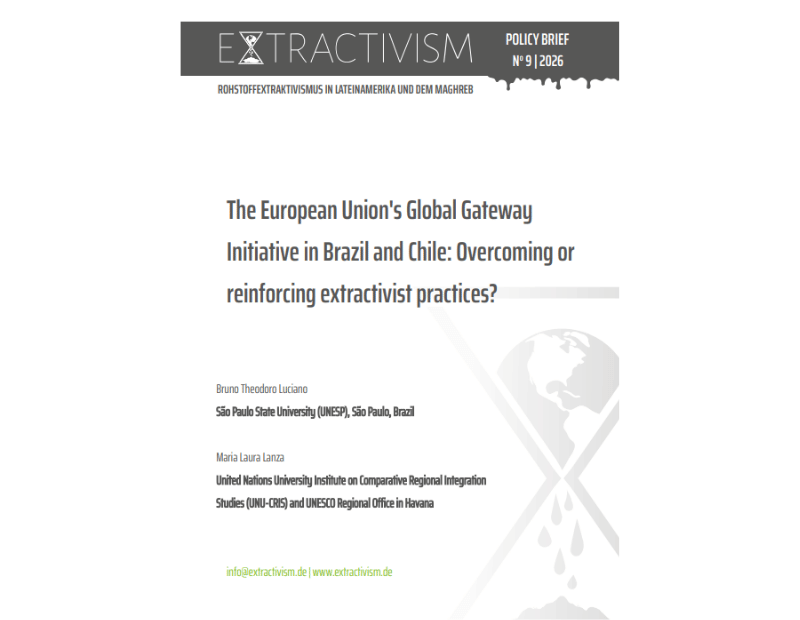
This Extractivism Policy Brief 09/2026 shows:
- The EU’s Global Gateway can be seen as a window of opportunity for the implementation of the SDGs in Latin America, given its emphasis on the development of climate and green energy projects.
- The predominance of investments in green hydrogen and critical raw materials projects has the potential to reinforce extractivist patterns in Latin America. While this is particularly evident in GG projects in Chile, in Brazil the GG agenda is more diversified, incorporating projects in areas such as digital connectivity, infrastructure, and sanitation.
- To contribute to the green transition and the implementation of the Sustainable Development Goals in the region, the Global Gateway must address many issues when repackaging previous European cooperation projects – particularly transparency, private-sector investment engagement, inclusion of local and social actors, and asymmetries at the design and implementation levels.
The Authors:
Dr. Bruno Theodoro Luciano is a Researcher at the Institute of Public Policies and International Relations, São Paulo State University (UNESP), Brazil. Associate Research Fellow at the United Nations University (UNU-CRIS), Belgium. Editor of the Journal Contemporary European Politics (Wiley/UACES). PhD in Political Science and International Studies from the University of Birmingham, United Kingdom. His research focuses on the political developments of the European UnionLatin America and Caribbean relations, examining their intergovernmental and interparliamentary dimensions. Currently the Principal Investigator of the Project ‘Examining the Design and Implementation of the EU’s Global Gateway Agenda to Latin America’, funded by the National Council for Scientific and Technological Development (CNPq), Brazil.
Maria Laura Lanza is a development and public policy practitioner with experience in international cooperation, governance, and human rights. She currently supports cultural and development initiatives at UNESCO’s Regional Office for Cuba, the Dominican Republic, Venezuela, and Haiti. Her previous roles as a trainee at the European Union Delegation to Cuba and the World Organization Against Torture involved policy analysis, stakeholder engagement, and research on socio-economic development, international cooperation, and human rights. She holds a master’s degree in international relations and public policy from the Université libre de Bruxelles and is currently pursuing a master’s degree in Economic Policy and Governance for Development and Resilience. Her academic and professional work focuses on development policy, governance, social inclusion, and EU–Latin America relations, with particular attention to Latin America and the Caribbean. She has contributed to research, policy reporting, and institutional cooperation initiatives across international and regional contexts.
Link to PDF: Download Extractivism Policy Brief 09/2026 (ENGLISH)