'/%3E%3C/svg%3E)
'/%3E%3Cpath%20fill='%23b2b2b2'%20d='M241%20382q0%2016%2017%2026%2017%2011%2042%2011t42-11q16-11%2017-26V269H241'/%3E%3Cpath%20fill='%239f7e00'%20d='M241%20379q0%2014%208%2023%209%209%2021%209%2014%200%2021-9%209-9%209-23V269h-59'/%3E%3Cpath%20d='M241%20339v-70h59v110q0%2014-9%2023l-6%205v-68h-15v72q-8%200-14-4v-68zm59%2040c0%2022%2015%2032%2029%2032%2021%200%2030-18%2030-32v-40h-59'/%3E%3Cpath%20fill='%239f7e00'%20d='M266%20277v5h2v12h-3v-5h2v-5h-9v5h2v5h-4v9h3v18h-5v10h34v-10h-5v-18h3v-9h-4v-5h2v-5h-9v5h2v5h-3v-12h2v-5zm42%20101q0%2010%206%2017%206%206%2015%207%2010-1%2016-7%206-7%206-17v-29h-43'/%3E%3Ccircle%20fill='%230044ad'%20cx='329.5'%20cy='372'%20r='6'/%3E%3Cellipse%20fill='%230044ad'%20cx='300'%20cy='340'%20rx='16'%20ry='21'/%3E%3C/svg%3E)

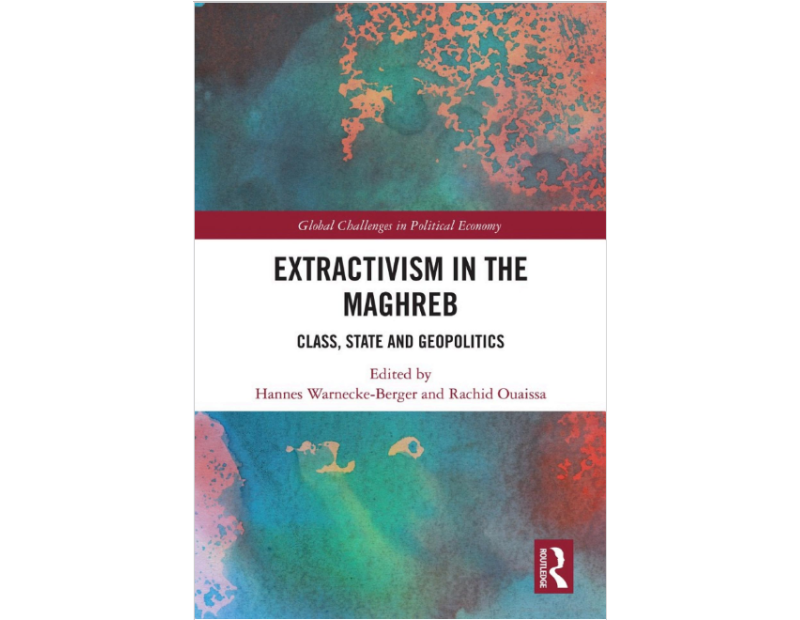
Extractivism researcher Dr. Kressen Thyen recently published a chapter in the edited volume Extractivism in the Maghreb: Class, State and Geopolitics, edited by Hannes Warnecke-Berger and Rachid Ouissa. The chapter examines the recent surge of protests in the Maghreb by linking them to the historical formation and contemporary contestation of resource nationalism.
Since the 2000s, strikes, occupations, and rural mobilizations have repeatedly disrupted extraction and intensified socio-spatial cleavages, revealing that conflicts over land, water, minerals, and hydrocarbons are rarely “only” about compensation or jobs. Rather, they articulate a broader state–society confrontation over exclusion, repression, and unequal citizenship.
The chapter argues that these dynamics are best understood through divergent, historically constituted understandings of resource sovereignty. In the Maghreb, the coincidence of decolonization with the international principle of Permanent Sovereignty over Natural Resources produced a hegemonic, state-centric resource nationalism: governments nationalized land, mines, and hydrocarbons to reclaim wealth from colonial extraction and promise welfare through national development. Yet the centralized appropriation of resources increasingly fed semi-rentier development trajectories in which revenues were redirected away from producing territories, while local communities bore the socio-environmental costs. This contradiction has generated a growing repertoire of claims that challenge state-centric nationalism from the following—through “resource regionalism” and local forms of land sovereignty—without necessarily rejecting the moral premise that resources should benefit “the people.”
Empirically, the chapter draws on comparative evidence from Algeria, Morocco, and Tunisia based on secondary literature, press sources in French and Arabic, and research conversations with activists and scholars. It distinguishes two dominant protest forms: (1) blockades and strikes at hydrocarbon and mining sites demanding jobs, infrastructure, environmental protection, and redistribution; and (2) rural and Amazigh mobilizations defending territory, land, and water access, and local authority. The conclusion shows how Maghreb states respond through a recurrent mix of selective concessions, fictitious employment, and repression—revealing both the limits of extractivist governance and the unresolved democratic question embedded in resource sovereignty itself.