


Extractivism Talks #13
Brazil's 2026 elections:
what should the world expect from Lula's term?
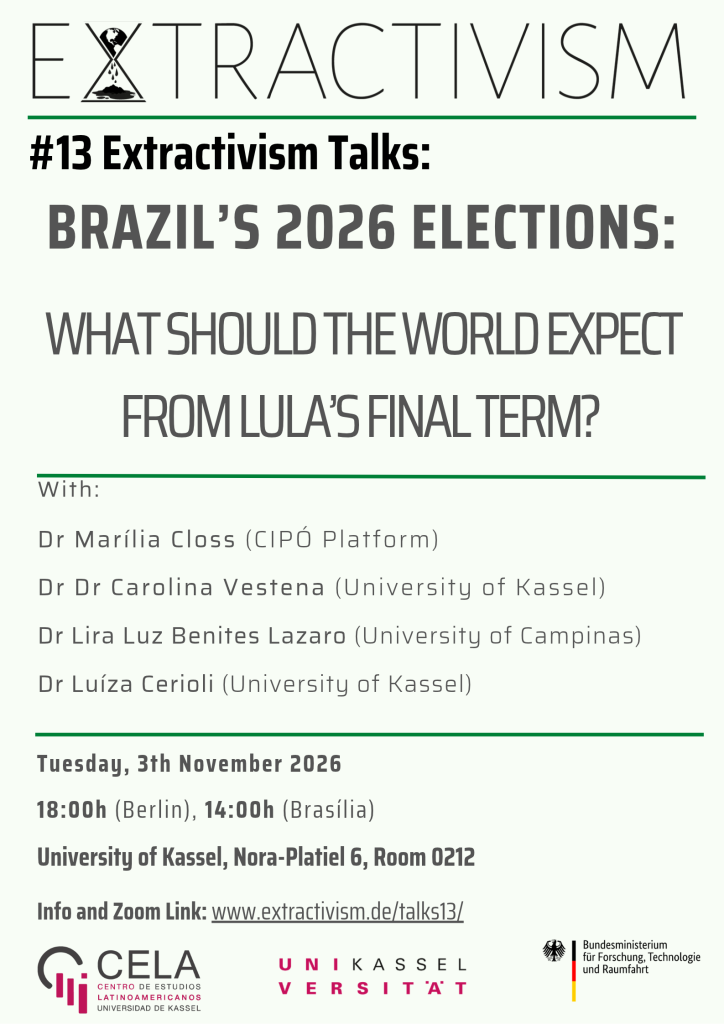
Extractivism Talks #13
The Extractivism Talks series acts as our platform for timely discussions on international affairs and current events. It explores the links between uneven global development and extractivist regimes in the Global South. The series encourages interdisciplinary conversations with unique insights into international conditions and opportunities for change in the Global South, with a particular focus on the Middle East and Latin America.
In Extractivism Talks #13, we discuss Brazil’s 2026 election cycle and what to expect from President Luiz Inácio Lula da Silva’s final term. On 4 October, Brazilians elected the most conservative Senate and Chamber of Deputies since redemocratization in 1988. Lula came second in the first round but defeated Senator Flávio Bolsonaro in the 25 October runoff. The election raises questions not only about Brazil’s political future, but also about the geopolitical reconfiguration of Latin America. We bring together four Brazilian scholars to examine the electoral results, the pathways to the left’s victory amid allegations of US interference in regional politics, the political and economic expectations for this new term, as well as the country’s socio-ecological continuities and challenges. The discussion will focus on how the election debate linked issues of sovereignty, control over critical minerals, and class politics, particularly around new labor and fiscal regulations. What does Lula’s victory mean for Latin America and the advance of right-wing governments in neighboring countries? How can Lula govern with a conservative majority in both legislative chambers? And what would continued polarisation mean for Brazilian society, environmental protection, democratic institutions, and economic stability?
Extractivism Talks #13 will be held on November 3rd from 18h to 20h at the University of Kassel, Nora-Platiel 6, Room 0212
It will also be live-streamed on Zoom from 18h to 20h. To join online, please register here: tba
Speakers:

Dr Marília Closs
Cipó Platform
Marília Closs’s work focuses on climate change, international governance, and Latin America. She conducts research, advocates for policy, and collaborates with public-sector institutions on climate change, with a particular focus on climate governance and international climate policy. She currently serves as Project and Research Coordinator at Plataforma CIPÓ, a Brazilian think tank advancing climate action and strengthening global governance. She holds a PhD and a Master’s degree in Political Science from the Rio de Janeiro State University.

Dr Lira Luz Benites Lazaro
University of Campinas
Lira Luz Benites Lazaro is a researcher with the Sustainable Campus Program at the State University of Campinas (UNICAMP) and the São Paulo Center for Energy Transition Studies (CPTEn), where she coordinates research on green hydrogen and the regulatory, technological, and industrial challenges of energy transitions in Mercosur. She specializes in climate and energy policy, energy transitions, and environmental governance. Her work explores the intersections of decarbonization agendas, natural resource extraction, socio-environmental justice, and sustainable development.

Dr Dr Carolina Vestena
University of Kassel
Carolina Vestena is a political scientist with a background in legal sociology. Her research focuses on Brazil, Latin America and Europe. She holds a PhD in legal sociology on social policies for poverty reduction during the first government of the Workers’ Party in Brazil and a PhD in political theory on collective legal mobilisation. Currently, she is an interim professor of political theory at the University of Kassel. This year, she published a contribution in the collection “Die politische Rechte in Lateinamerika” about the discourses and networks of “Bolsonarismo” in Brazil.

Dr Luíza Cerioli
University of Kassel
Luíza Cerioli is the Director of the Extractivism.de project. In the project, she leads transnational, cross-comparative research on Latin America and the Middle East, focusing on the development pathways of Venezuela, Brazil, Saudi Arabia, Zambia and Algeria. On Brazil, she focuses on the country’s development strategies amid the energy transition, international positioning, and the possibilities for green industrialization. Her work examines how these resource-rich states navigate global geopolitical competition and pursue development strategies that combine extractivism, industrial policy, and efforts to reposition themselves in the international system. She holds a PhD in Political Science from the University of Marburg and an MA in IR from the University of Brasília.
The venue
University of Kassel
Nora-Platiel 6
Room 0212
Link for Zoom:
tba