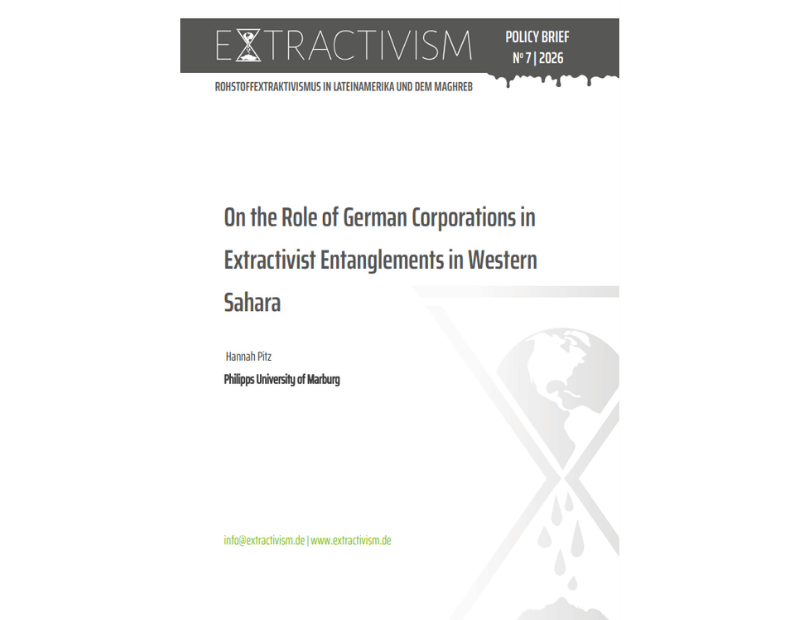
This Extractivism Policy Brief 07/2026 shows:
• Renewable energy projects in contested territories reproduce colonial structures and geopolitical power relations.
• There are three central mechanisms that reproduce colonial structures and power relations: structural enablement through legal ambiguity, economic optimisation of resource exploitation through “clean” technologies, and discursive legitimation via sustainability narratives.
• Under the guise of climate policy action, extractivism is made more efficient, cost-effective, and internationally compatible.
Author: Hannah Pitz is a Student Assistant in the Extractivism project at Philipps University Marburg. Her research interests are postcolonial theory and political sociology in the context of extractivism, energy politics and societal transformation processes in North Africa. She studied Sociology and Near and Middle Eastern Studies at Philipps University Marburg and the Cairo University and is currently pursuing her Master’s degree in Islamic Studies and Modern Arabic Politics, Society and Culture at the Philipps University Marburg.
Link to PDF: Download Extractivism Policy Brief 07/2026 (GERMAN)
Link to PDF: Download Extractivism Policy Brief 07/2026 (ENGLISH)